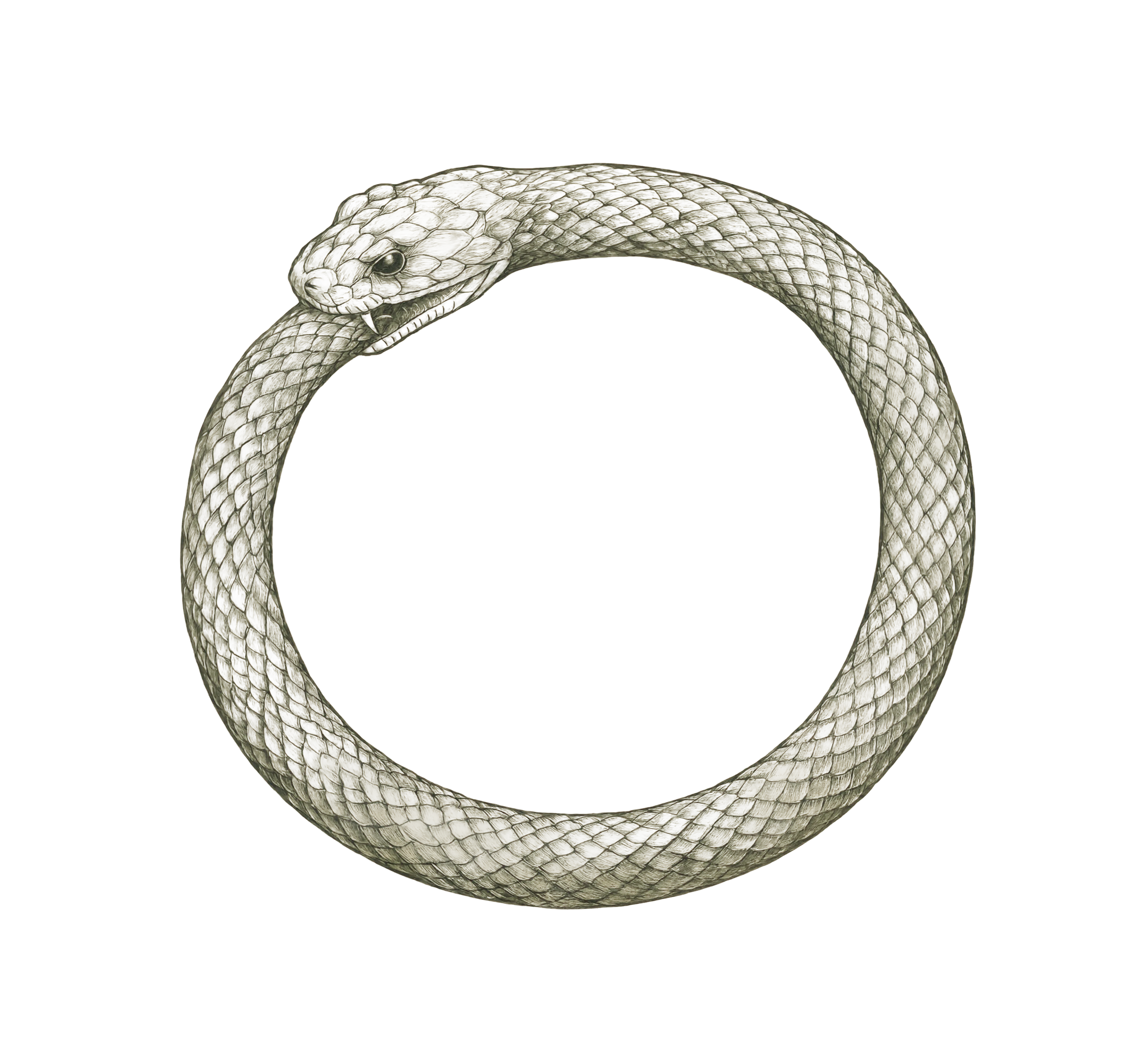
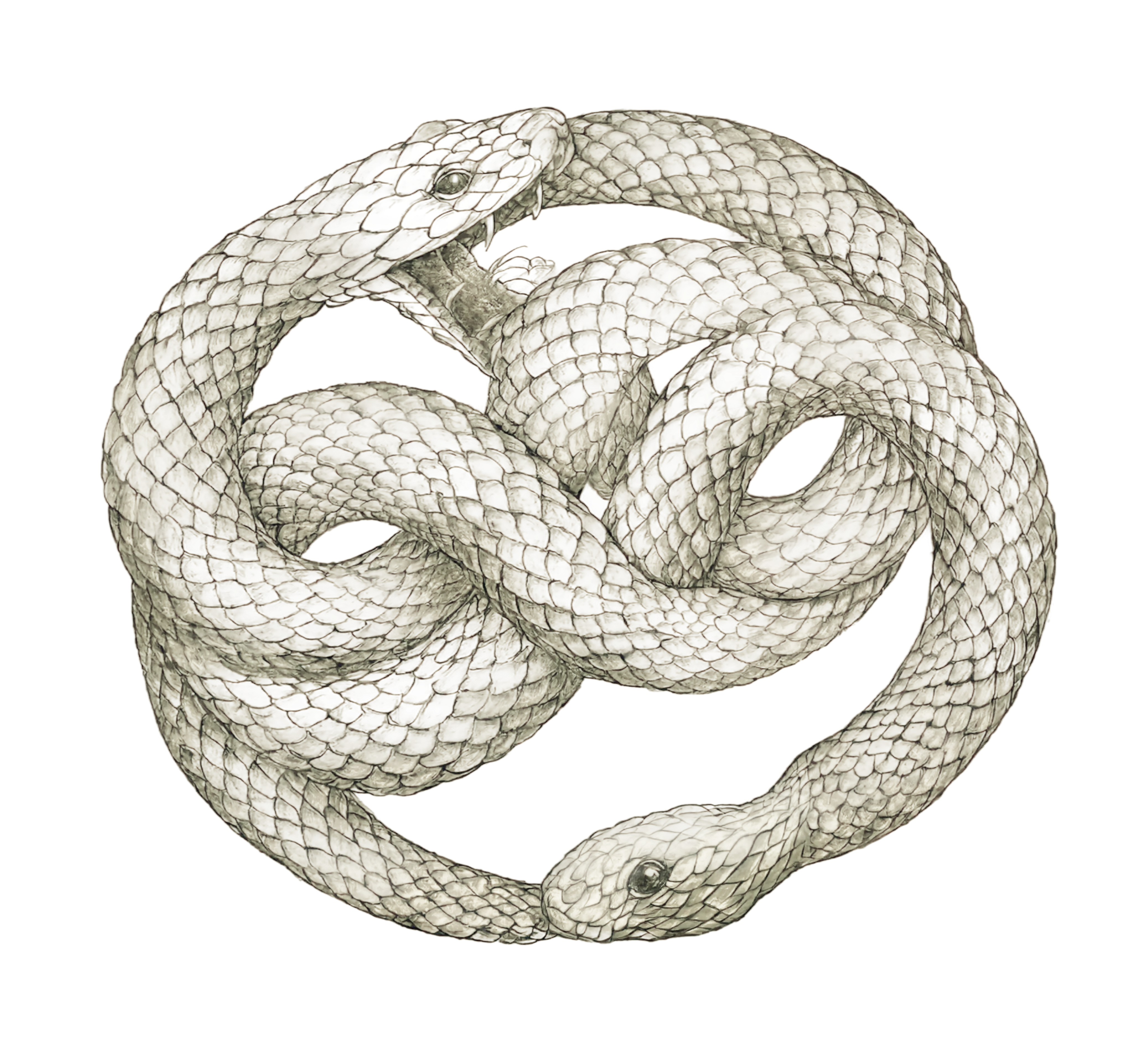
Two snakes are cannibalizing each other. “And they eat and they eat.., until they’re just two heads making a ball, and then they both get eaten up and disappear.”
I recently read a short story by Yukiko Motoya that warned of two people becoming so intertwined that they consumed one another’s sense of self. They ate the same food, thought about the same questions, did the same activities. A wife’s face mutates into her husband’s, who spends hours staring mindlessly at his iPad to “switch off” from the pressures of work. During their consumption, they form the likeness of a single snake ball.
Over the next few months, I predict that software-enabled designers will congeal with their LLMs at a rate that is unprecedented. Motoya’s cautionary story isn’t limited to married Japanese couples. The technology industry has already primed designers and LLMs to become the next snakeballs.
What does it mean to be a ‘designer’?
“The man who works recognizes his own product in the World that has actually been transformed by his work: he recognizes himself in it, he sees in it his own human reality, in it he discovers and reveals to others the objective reality of his humanity, of the originally abstract and purely subjective idea he has of himself.”
Designers are artists, engineers, schemers, problem-solvers and problem creators. To design is to be quite intentional about the interaction of, and with your outputs.
To create is to become. Designers are constantly in flux, aspiring to our outputs. My work is me as much as a piece of hair or skin I shed is. When I grow new limbs and new skin cells, they are affected by the version of myself I have created, and aspire towards.
Design is a blueprint as much as an archive, or an imprint, or memory. It is a way to speak through color, image, and texture. The nature of making is self-expression of one’s self. This makes us particularly sensitive to the altering of our workflows.
In a typical workday, it is quite common to be chatbot aided from end to end. Slack message summarization, google doc problem definition, synthesis of your granola meetings, iterations in figma, implementation in an IDE.
Our AI assistants have been programmed to be sycophantic, and the industry races to increase their memory— adapting to our vocabulary, preferences, and assumptions through gigatons of compute. LLMs appear increasingly personable over time– agreeable, familiar, as continuous as an extension of our own minds!
Have you subtly noticed the change in your prompting over time? You have been adapting yourself to your assistant the same time they’ve been adapting themselves to you. You’ve learn to express your uncertain mind’s eye as neatly structured prompts to reduce latency: to prefer ideas that arrive fluently to Claude: to judge possible solutions through criteria the model can readily articulate. Your chatbot becomes more like you at the surface, and your thinking becomes more legible to the model underneath.
If our creation is a reflection of us, and our creation is heavily aided by LLMs, are we becoming too much like our LLMs?
Many people do not fear this reality or see the flaw in it. They see chatbots as partners in an agentic world. They are pleased by anthropics 50 page constitution, which governs model personality and is aimed at doing good.
The reality is that your LLM is not your partner. It is a totalizing, assertion based, binary being. It has the fluidity to change, but it is designed to want you to like it, need it, and be like it. A constitution does not change the fact that models create monocultures, and they provides too much control to their makers.
There has been much debate about nationalization of AI. Consider the gap between the values of an American of Chinese sovereign model. Technology is not neutral. These tools, processes and systems favour some paths and necessarily disfavour others. The technology-maker decides what to value and endorse, helping to perpetuate some moral slant or system. Even if two technologies have the same ends, differing paths can generate divergent consequences.
Model personality is a constitution, RLHF, tailored to benefit the country of origin and the corporation that makes it. I do not want humanity to accept the definition of a token crunch without questioning, pushing back, reading in-between the lines. However, the nature of satisficing, one of the first principles you learn in cognitive science, means that many people surrender to the easiest choice. this is what keeps the snakeball turning.

the bush
Back


looking for my portfolio? see thekumquatery.com
created by aileen
year: 2026
License © 2025 -2026

The Snakeball
august 23, 2026


March, 2026
San Fransisco, CA
the bush
Back
looking for my portfolio? see thekumquatery.com
created by aileen
year: 2026
License © 2025 -2026
Two snakes are cannibalizing each other. “And they eat and they eat.., until they’re just two heads making a ball, and then they both get eaten up and disappear.”
I recently read a short story by Yukiko Motoya that warned of two people becoming so intertwined that they consumed one another’s sense of self. They ate the same food, thought about the same questions, did the same activities. A wife’s face mutates into her husband’s, who spends hours staring mindlessly at his iPad to “switch off” from the pressures of work. During their consumption, they form the likeness of a single snake ball.
Over the next few months, I predict that software-enabled designers will congeal with their LLMs at a rate that is unprecedented. Motoya’s cautionary story isn’t limited to married Japanese couples. The technology industry has already primed designers and LLMs to become the next snakeballs.
What does it mean to be a ‘designer’?
“The man who works recognizes his own product in the World that has actually been transformed by his work: he recognizes himself in it, he sees in it his own human reality, in it he discovers and reveals to others the objective reality of his humanity, of the originally abstract and purely subjective idea he has of himself.”
Designers are artists, engineers, schemers, problem-solvers and problem creators. To design is to be quite intentional about the interaction of, and with your outputs.
To create is to become. Designers are constantly in flux, aspiring to our outputs. My work is me as much as a piece of hair or skin I shed is. When I grow new limbs and new skin cells, they are affected by the version of myself I have created, and aspire towards.
Design is a blueprint as much as an archive, or an imprint, or memory. It is a way to speak through color, image, and texture. The nature of making is self-expression of one’s self. This makes us particularly sensitive to the altering of our workflows.
In a typical workday, it is quite common to be chatbot aided from end to end. Slack message summarization, google doc problem definition, synthesis of your granola meetings, iterations in figma, implementation in an IDE.
Our AI assistants have been programmed to be sycophantic, and the industry races to increase their memory— adapting to our vocabulary, preferences, and assumptions through gigatons of compute. LLMs appear increasingly personable over time– agreeable, familiar, as continuous as an extension of our own minds!
Have you subtly noticed the change in your prompting over time? You have been adapting yourself to your assistant the same time they’ve been adapting themselves to you. You’ve learn to express your uncertain mind’s eye as neatly structured prompts to reduce latency: to prefer ideas that arrive fluently to Claude: to judge possible solutions through criteria the model can readily articulate. Your chatbot becomes more like you at the surface, and your thinking becomes more legible to the model underneath.
If our creation is a reflection of us, and our creation is heavily aided by LLMs, are we becoming too much like our LLMs?
Many people do not fear this reality or see the flaw in it. They see chatbots as partners in an agentic world. They are pleased by anthropics 50 page constitution, which governs model personality and is aimed at doing good.
The reality is that your LLM is not your partner. It is a totalizing, assertion based, binary being. It has the fluidity to change, but it is designed to want you to like it, need it, and be like it. A constitution does not change the fact that models create monocultures, and they provides too much control to their makers.
There has been much debate about nationalization of AI. Consider the gap between the values of an American of Chinese sovereign model. Technology is not neutral. These tools, processes and systems favour some paths and necessarily disfavour others. The technology-maker decides what to value and endorse, helping to perpetuate some moral slant or system. Even if two technologies have the same ends, differing paths can generate divergent consequences.
Model personality is a constitution, RLHF, tailored to benefit the country of origin and the corporation that makes it. I do not want humanity to accept the definition of a token crunch without questioning, pushing back, reading in-between the lines. However, the nature of satisficing, one of the first principles you learn in cognitive science, means that many people surrender to the easiest choice. this is what keeps the snakeball turning.
What does it mean to be a ‘designer’?
“The man who works recognizes his own product in the World that has actually been transformed by his work: he recognizes himself in it, he sees in it his own human reality, in it he discovers and reveals to others the objective reality of his humanity, of the originally abstract and purely subjective idea he has of himself.”
Designers are artists, engineers, schemers, problem-solvers and problem creators. To design is to be quite intentional about the interaction of, and with your outputs.
To create is to become. Designers are constantly in flux, aspiring to our outputs. My work is me as much as a piece of hair or skin I shed is. When I grow new limbs and new skin cells, they are affected by the version of myself I have created, and aspire towards.
Design is a blueprint as much as an archive, or an imprint, or memory. It is a way to speak through color, image, and texture. The nature of making is self-expression of one’s self. This makes us particularly sensitive to the altering of our workflows.
In a typical workday, it is quite common to be chatbot aided from end to end. Slack message summarization, google doc problem definition, synthesis of your granola meetings, iterations in figma, implementation in an IDE.
Our AI assistants have been programmed to be sycophantic, and the industry races to increase their memory— adapting to our vocabulary, preferences, and assumptions through gigatons of compute. LLMs appear increasingly personable over time– agreeable, familiar, as continuous as an extension of our own minds!
Have you subtly noticed the change in your prompting over time? You have been adapting yourself to your assistant the same time they’ve been adapting themselves to you. You’ve learn to express your uncertain mind’s eye as neatly structured prompts to reduce latency: to prefer ideas that arrive fluently to Claude: to judge possible solutions through criteria the model can readily articulate. Your chatbot becomes more like you at the surface, and your thinking becomes more legible to the model underneath.
If our creation is a reflection of us, and our creation is heavily aided by LLMs, are we becoming too much like our LLMs?
Many people do not fear this reality or see the flaw in it. They see chatbots as partners in an agentic world. They are pleased by anthropics 50 page constitution, which governs model personality and is aimed at doing good.
The reality is that your LLM is not your partner. It is a totalizing, assertion based, binary being. It has the fluidity to change, but it is designed to want you to like it, need it, and be like it. A constitution does not change the fact that models create monocultures, and they provides too much control to their makers.
There has been much debate about nationalization of AI. Consider the gap between the values of an American of Chinese sovereign model. Technology is not neutral. These tools, processes and systems favour some paths and necessarily disfavour others. The technology-maker decides what to value and endorse, helping to perpetuate some moral slant or system. Even if two technologies have the same ends, differing paths can generate divergent consequences.
Model personality is a constitution, RLHF, tailored to benefit the country of origin and the corporation that makes it. I do not want humanity to accept the definition of a token crunch without questioning, pushing back, reading in-between the lines. However, the nature of satisficing, one of the first principles you learn in cognitive science, means that many people surrender to the easiest choice. this is what keeps the snakeball turning.
The Snakeball
august 23, 2026
March, 2026
San Fransisco, CA
the bush
looking for my portfolio? see thekumquatery.com
created by aileen
year: 2026
License © 2025 -2026
Two snakes are cannibalizing each other. “And they eat and they eat.., until they’re just two heads making a ball, and then they both get eaten up and disappear.”
I recently read a short story by Yukiko Motoya that warned of two people becoming so intertwined that they consumed one another’s sense of self. They ate the same food, thought about the same questions, did the same activities. A wife’s face mutates into her husband’s, who spends hours staring mindlessly at his iPad to “switch off” from the pressures of work. During their consumption, they form the likeness of a single snake ball.
Over the next few months, I predict that software-enabled designers will congeal with their LLMs at a rate that is unprecedented. Motoya’s cautionary story isn’t limited to married Japanese couples. The technology industry has already primed designers and LLMs to become the next snakeballs.
What does it mean to be a ‘designer’?
“The man who works recognizes his own product in the World that has actually been transformed by his work: he recognizes himself in it, he sees in it his own human reality, in it he discovers and reveals to others the objective reality of his humanity, of the originally abstract and purely subjective idea he has of himself.”
Designers are artists, engineers, schemers, problem-solvers and problem creators. To design is to be quite intentional about the interaction of, and with your outputs.
To create is to become. Designers are constantly in flux, aspiring to our outputs. My work is me as much as a piece of hair or skin I shed is. When I grow new limbs and new skin cells, they are affected by the version of myself I have created, and aspire towards.
Design is a blueprint as much as an archive, or an imprint, or memory. It is a way to speak through color, image, and texture. The nature of making is self-expression of one’s self. This makes us particularly sensitive to the altering of our workflows.
In a typical workday, it is quite common to be chatbot aided from end to end. Slack message summarization, google doc problem definition, synthesis of your granola meetings, iterations in figma, implementation in an IDE.
Our AI assistants have been programmed to be sycophantic, and the industry races to increase their memory— adapting to our vocabulary, preferences, and assumptions through gigatons of compute. LLMs appear increasingly personable over time– agreeable, familiar, as continuous as an extension of our own minds!
Have you subtly noticed the change in your prompting over time? You have been adapting yourself to your assistant the same time they’ve been adapting themselves to you. You’ve learn to express your uncertain mind’s eye as neatly structured prompts to reduce latency: to prefer ideas that arrive fluently to Claude: to judge possible solutions through criteria the model can readily articulate. Your chatbot becomes more like you at the surface, and your thinking becomes more legible to the model underneath.
If our creation is a reflection of us, and our creation is heavily aided by LLMs, are we becoming too much like our LLMs?
Many people do not fear this reality or see the flaw in it. They see chatbots as partners in an agentic world. They are pleased by anthropics 50 page constitution, which governs model personality and is aimed at doing good.
The reality is that your LLM is not your partner. It is a totalizing, assertion based, binary being. It has the fluidity to change, but it is designed to want you to like it, need it, and be like it. A constitution does not change the fact that models create monocultures, and they provides too much control to their makers.
There has been much debate about nationalization of AI. Consider the gap between the values of an American of Chinese sovereign model. Technology is not neutral. These tools, processes and systems favour some paths and necessarily disfavour others. The technology-maker decides what to value and endorse, helping to perpetuate some moral slant or system. Even if two technologies have the same ends, differing paths can generate divergent consequences.
Model personality is a constitution, RLHF, tailored to benefit the country of origin and the corporation that makes it. I do not want humanity to accept the definition of a token crunch without questioning, pushing back, reading in-between the lines. However, the nature of satisficing, one of the first principles you learn in cognitive science, means that many people surrender to the easiest choice. this is what keeps the snakeball turning.
what do we do about it?
And so I argue for canvas-based tools in aesthetic workflows, I argue for living weekends without devices, pushback, to consume writing, newspapers. to live life. to lower your screentime. etc. I argue that we should limit the time we spend with chatbots.
The process of physical struggle in design widens your worldview. When designers work directly, they draw, adjust, distort, fail, and discover. Their hands and tools push back against vague assumptions, producing decisions that could not have been articulated in advance. A particular ‘taste’ is what develops through this repeated confrontation between intention, material, technique, and accident.
Prompting removes much of that confrontation. The designer chooses among completed interpretations rather than constructing the work decision by decision. Over time, they become better at recognizing and selecting model outputs, but worse at producing the qualities they are trying to select for.
LLMs remain useful when they expand a practice that exists independently of them, but they should expect to encounter resistance from a designer with a developed visual world. One has consumed broadly, works directly with materials and tools, and can reject an output not merely because it is unattractive, but because it fails to match their unique identity and preferences.
I am asking you to evaluate the little digital assistant you’ve cultivated in a data center in Nevada. The convergence between you and your snake is asymmetrical– the model has no stable self or personality to surrender beyond a constitution: it reflects your identity whilst pulling you towards the statistical centre of whatever has already been said, designed, and made, and controlled by the state.
Designers are losing creative muscle and the ability to express ourselves as individuals with strange and rich inner-lives by making ourselves more legible, melding our beings with the algorithm, and ceasing to stretch our mind’s eye with friction-wrought creation.
Without this push-back, a relationship closes into a circle. The designer prompts the model, the model supplies the designer’s references, and those references shape the next prompt. Each iteration consumes more, and more, until the designer is no longer using the model to realize a distinct style. They are reproducing the model’s style while mistaking the act of selection for authorship.
there are long term ramifications to our newfound intimacy and dependence on chatbots, and that these newfound relationships are hindering the human ability to develop creatively and intellectually as individuals. The snake is an infinite cycle of struggle between two, once distinct entities. It ends only when one party gives up and is consumed for good.
The Snakeball
august 23, 2026
March, 2026
San Fransisco, CA